Sunday, July 1, 2012

New Orleans: A Weekend in Pictures

Diana and I have been talking since the beginning of the summer about heading down to New Orleans at some point. We'd been told that Amtrak tickets were cheap--about $20 each way--but when we checked on Tuesday, they were $50 a piece in each direction. On Wednesday we found out that one of the Education Fellows from the office was planning to drive down this weekend, and she agreed to take us with. Then began the work of finding a place to stay. Hostels were always an option, but we wanted to go more the route of CouchSurfing. So I emailed a bunch of Princeton New Orleans alumni to no avail (everyone was out of town/moving/having in-laws over); then I remembered that a few people from high school went to Tulane. Turns out a couple stayed in New Orleans for the summer, and one offered to let the three of us (our friend Jo from the office came with, too) crash at her place in Uptown. It was about a mile north of the St. Charles Streetcar, which took us everywhere we wanted to go (or close enough).

We got to New Orleans a couple hours before Charlotte (who's place we stayed at) got off work, so we spent a couple hours wandering up and down Magazine St. In front of the hostel where we snagged a (very bad) map of the city, we found a cut-off branch of plantains sitting in the street. There were three perfectly ripe ones, which we ate right then and there, and then a whole bundle of still-green ones, which we carried with us the rest of the afternoon and brought back with us to Jackson. We got some funny looks walking around with it, but one woman stopped us and gave us some great ideas for how to eat them! 
Also on Magazine St. This is just on the porch of a private home. 

One of the first things we saw was this wall o' taps. Who knew one restaurant had so many kinds of beer!
We headed back to Charlotte's place to drop our stuff off, cool down, and figure out the evening. I had contacted the rabbi of Anshe Sfard, the Orthodox synagogue within New Orleans proper, earlier in the day to find out if they had Friday night services. The answer was no, but it came with an invitation to Shabbat dinner, which I accepted happily. Though I went into the summer knowing that my Shabbat experiences would be very different from what I'm used to, I'd feel weird not doing anything Shabbat-y at all. So I headed over there and had dinner with the Rabbi and Rebbetzin, and two Israeli girls roadtrip-ing from Connecticut to California and back.

After dinner, I went to meet up with Diana and Jo at Tipitina's, a bar/jazz club near the river that was having a good New Orleans brass band and later a jazz band. My plans got interfered with a bit by my brother's friend, Jesse, who lives in New Orleans, who insisted on picking me up to drive me there rather than have me walk alone. (Thanks, Jesse!)

On Saturday we headed out to the French Quarter, infamously the home of Bourbon St--which is every bit as ridiculous as what you'd imagine. But before we began our wandering, we got breakfast at a place called Nosh, where I got sweet potato pancakes (so good). 

The following are pictures from the French Quarter:
This kind of intricate lacy ironwork decoration is a staple of classic New Orleans architecture.  

Mardi Gras is a huge part of New Orleans culture, even not during Mardi Gras. Every tourist shop had  Mardi Gras beads, and half the trees and telephone wires in the city were draped with beads people had thrown in the air (during the parade, I assume). I've got some pictures of very inappropriate ones, but figured those shouldn't go on the blog...


This is in the French Market, an outdoor flea/art/produce  market in the French Quarter.  Airship Isabella had a stall where they were making some of their "steampunk leather and accessories" on the spot. One of the guys showed me how to dye and stamp the leather. Another showed me his leather wristband (pictured), which has a phone holder and keyboard for his phone, which hooks up to the bluetooth he had attached to his ear (with a hand-made leather cover, of course).

Jackson Square Park, named, of course, for Andrew Jackson. I'm pretty sure this is what Disney's logo is based off of.  Behind the park is a cathedral, next to which stands the Cabildo, once the center of government in New Orleans, and the site of the ceremonies associated with the Louisiana Purchase in 1803.

From Jackson Square Park, the three of us split off into different directions to go exploring on our own. I walked along the River, and came across a placard for the Woldenberg Riverwalk Park (the same Woldenberg of Goldring/Woldenberg Institute of Southern Jewish Life)--and later a Holocaust Memorial funded by the Goldring family.
In any case, there's a free ferry that runs from Canal St. across the Mississippi River to Algiers Point. I took the ferry across and then back, and this is a shot from the boat. The River is not that wide there!

During my wanderings I heard some nice loud music coming from a few blocks away, and followed the sound until I found this brass band playing on a street corner in front of a Foot Locker. They were great, and I stopped to listen for a while before heading out for some more exploring. 

There were a lot of good doors, but I didn't want to flood this post with pictures of doors (when I put up albums later, there will be plenty of doors). This was one of my favorites. From the French Quarter. 

On my way back to meeting Diana and Jo at our designated meet-up, I passed an art gallery that  had easels and canvases everywhere, including all the way up to the ceiling and stacked on the floor. Turns out it was the gallery of Adrian Fulton, a helicopter mechanic in Lafeyette, LA (originally from Philadelphia) who has three art galleries in the New Orleans area that he uses as refuge from his "day job" of engineering. Only upon looking at his website just now did I find out that Fulton was one of the artists invited by former First Lady Laura Bush to the White House a few Christmases ago--an ornament he designed was one of the decorations on the tree in the Blue Room of the White House.
While I was in his studio/gallery, he asked if I was of legal drinking age. He looked disappointed when I said no, and then pointed to the wine he usually passed out to visitors. Looks like I'll just have to go back to New Orleans after September! 

While waiting in the park, Diana saw a woman carrying a Hebrew workbook sit down on a bench. Naturally, I went over to talk to her. Turns out she's also living in Jackson for the summer (and went to college a couple blocks from my high school!), so we chatted for a while and ended with an email exchange and an open offer for Hebrew help.

Then it was time for a snack. Since we were a block away from the famous, 24-hour Cafe Du Monde, we couldn't not go. So we went. We got an order of beignets (basically, fried dough with powdered sugar on top) to split between the three of us and they were delicious! But we were still hungry...so off in search of dinner we went. We'd gotten a recommendation and followed through on it--it was yummy, but fancier than we thought, and smaller portions than we'd expected given the prices. The wandering continued, with Frenchman Street (lots of live music) the eventual destination.
On our way, we passed this building with shiny red  glass preventing anyone from looking in. Strip club, we're pretty sure.

The walk to Frenchman St. was long, so we took the streetcar that ran along the river. Just like in San Francisco, streetcars are an actual mode of transportation used not only by tourists. 

We'd gotten a couple suggestions for venues to check out, but had to stop at a street party we heard from blocks away. We weren't really sure what it was--flash mob? Dance party? Organized?--because it didn't look like everyone knew each other, yet at the same time there were lots of people with umbrellas and parasols who knew to bring them. 
And there was a strange beast-head (?) built of tin with neon lights dangling down with a shopping cart as its base structure. The boombox providing the music was coming from somewhere inside the structure.
Then we went to a couple of other clubs and saw some great live music! I couldn't go into many of the clubs, but there were still a bunch of goods ones that are 18+. When we got to The Maison, the FauxBarrio Billionaires, a band Diana had seen in New Orleans a few months ago, were playing. I'm not sure exactly what I would call their music, but it's got some jazz and blues, maybe some klezmer, some soul--and a washboard. We had to run out in the middle to say hi to our boss Stuart and his wife, who were also in New Orleans this weekend and had just walked by. Upon Jesse's suggestion, I went to the second floor of the Blue Nile, where a band whose name I never knew was playing. The lead singer was a man whose sultry, classic-Blues voice was one both Diana and I thought belonged to a woman. They were so good they almost had me up and dancing--and I don't dance!

We caught a cab home, and I have never been more scared of somebody else's driving (except perhaps one time in Hungary). Imagine a combination of start-and-stop gridlocked traffic with 80 mph tailgating. Now imagine worse. We got back to Charlotte's safely, surprisingly, and quickly.

This morning we went out in the direction of the Tulane and Loyola campuses in search of breakfast. Luckily, the place we'd been planning on was closed ("for summer vacation"), and we wandered into a place called Chill Out Cafe, which is "Breakfast & Asian Fusion". That means it's a Thai restaurant that realized it could get a much bigger draw from college students if it added classic American breakfast foods (with a southern twist--there was a shrimp omelette option).

Then we split up again for our last few hours. I decided to see if the Touro Synagogue (one of three reform temples in New Orleans proper; the first synagogue outside the original 13 colonies, and the sixth oldest in the country) was open. It wasn't, so instead I wandered through the Garden District, in awe at the size of the single-family homes I saw lining the streets. By this point, I was literally dripping with sweat--apparently, it only hit about 93 degrees, but the humidity made it feel much worse. I think I probably had 5 liters of water just in the couple hours I was out.


One of the places I wandered into was Lafayette Cemetery No. 1. What distinguishes these old New Orleans cemeteries from most is that the tombs are above-ground (because of the water). 


This tomb stood out, because it didn't have a big above-ground mausoleum.
  
Like I said before, Mardi Gras decorations remain visible year-round, draped on telephone wires and trees. 


This chicken-cage truck is actually from the drive to New Orleans. We had to peel our eyes away from the Bayou and the (former) longest bridge in the world (the Lake Pontchartrain Causeway) to take a look at the truck driving next to us. 
Coincidentally, the ride home included a stop at Kosher Cajun, where I bought--what else--chicken.

Tuesday, June 19, 2012

Oklahoma Roadtrip Essentials: Driving, Eating, Researching

This post is meant to be a summary of the Oklahoma trip until this point. I think I may have listed inccorect towns in the most recent post, so here's the communities we'll have gone to/researched by the end of the trip (tomorrow night we'll be back in Jackson): Ardmore, Ada, Seminole/Shawnee, McAlester/Hartshorne/Wilburton. So far we've done all but Hartshorne and Wilburton.

Essentially, our days are split into three things: 1) Driving, 2) Eating, 3) Researching. The researching part is actually my favorite--I haven't taken any class so far at Princeton that's really taught me how to do research in the way that I've learned to do it even in the past three days. Say, for example, you come across a tiny town in the middle of a state without a lot of Jews. Oklahoma, for example. How do you tell if there were ever Jews there? Well, you scroll through microfilms of old newspapers from the dates surrounding Rosh Hashanah and Yom Kippur and see if there were any store closings "in observance of the Jewish Holiday"--or if there are any stores with Jewish-sounding names. Or you check out a city directory and look through the stores looking for Jewish names--then you look up those names and see where else they pop up. It's really very cool!. 

One of my half-joke conclusions since starting this research is that there were ever about 12 Jewish families at the most, and they all just married each other. This, of course, is not true--some of these communities had more than 12 families themselves. But it really does feel like they're all related to each other by marriage or through business--everyone we've spoken with has known of everyone we've mentioned (and half the time they're related). And we've gotten to speak with a couple different people--at least one community member in each town we've visited, which has been a really great way to get a feel for what the Jewish community was like but also just to gain some perspective on living in Oklahoma. Everyone has been so friendly, and each has treated us to a meal at a delicious restaurant.

The speed limit in Texas. This is not a joke.

The temple in Ardmore, OK. It hasn't been used in more than a decade, but the building is still sitting there because it's full of asbestos and therefore too expensive to tear down. There are still choir/High Holiday gowns hanging in the closet (the building was locked, but we could see through the windows). 

http://wowchurch.org in Ardmore, OK 
Mount Zion Cemetery, the Jewish Cemetery in Ardmore, OK is still very well maintained, despite the folding of the synagogue more than a decade ago (see picture above). In fact, when we were there, the lawn maintenance crew was as well, and the grass looked beautiful and the gravestones very well kept. We went to the cemetery after we'd done a lot of research in the newspapers and city directories, so we knew stories about lots of the people we saw in the cemetery.

The library in Ardmore, OK was really helpful. They had lots of books on local history, and lots of old papers on microfilm. They also had hundreds of newspaper clippings shoved into vertical files, which were incredibly tedious to weed through, but incredibly worthwhile because a lot of our new information came from those articles.

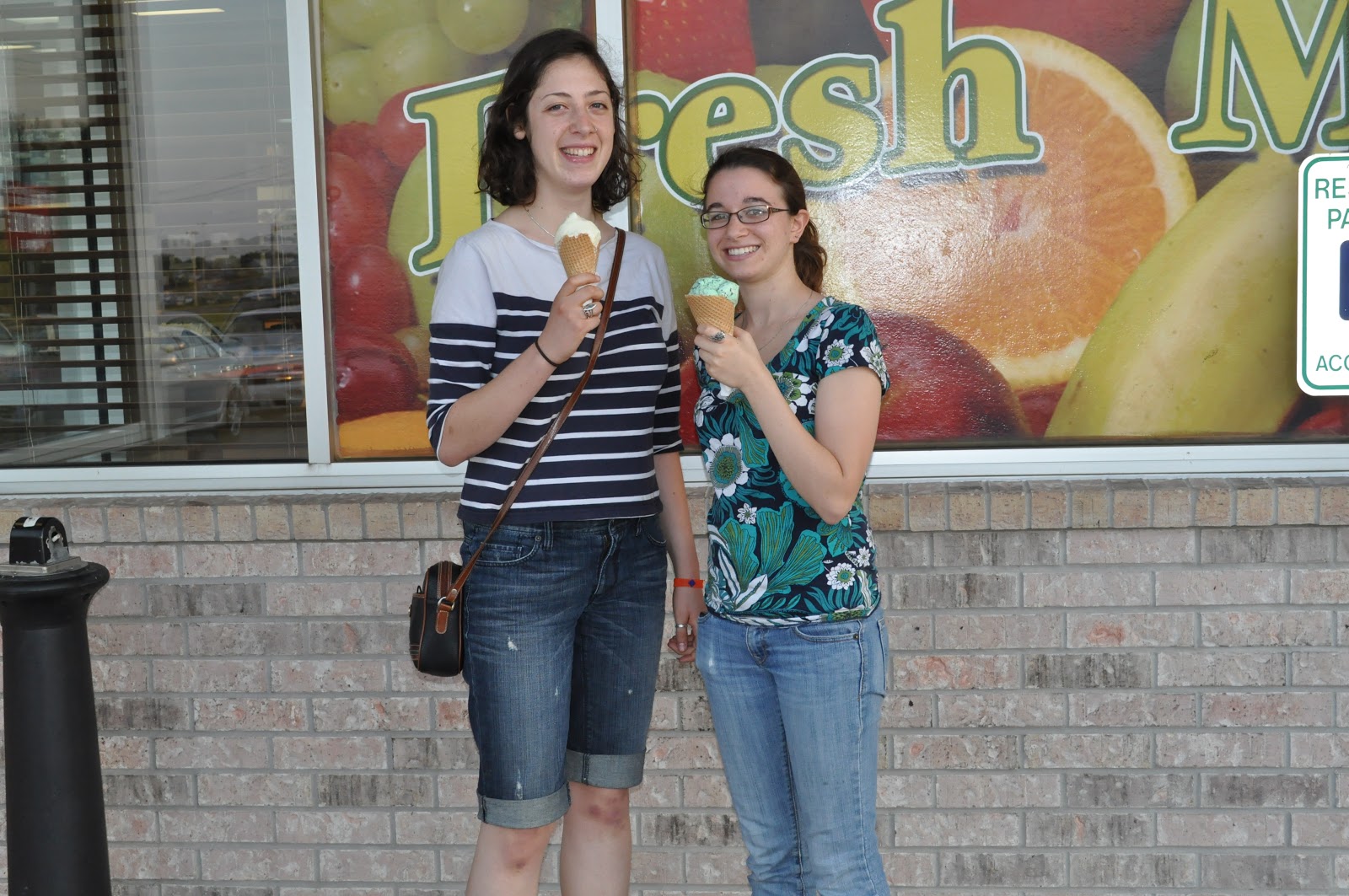
Ice cream at Braum's, a state-wide chain of extra-cheap, extra-delicious ice cream (they only have stores within a 300-mile radius of the home farm, so that the ice cream is extra-fresh). Uniquely, the ice cream (and also hamburger?) chain has a Fresh Market attached to it, which is exactly what it sounds like. 

Over the course of this week I've gotten to see a lot of Main Street America.  A highlight from one of the tens of pawnshops we've seen (these towns seem to be mainly comprised of pawnshops, thrift stores, gas stations, and bad diners). Don't get me wrong, I find them completely charming. 
At the Ada library, I was mostly looking through old newspapers (hard copies, not microfilms!) which was really fascinating. The advertisements in those old papers are top-notch.

This is Oklahoma. It's great. The winds really do blow through (last night I was sure there was going to be a tornado. Our hotel in Shawnee even had What-to-do-in-case-of-a-tornado info sheets pasted to the desk)

This is Hamburger King in Shawnee, where you place your order from a telephone at your booth. They were out of tuna, so I had an American Cheese grilled cheese sandwich, which was greasy and on white bread. The fries, however, were perfect. 

We haven't been doing much walking--mostly, as I listed above, driving, eating, and researching. So after dinner we made Stuart go for a walk to see what Shawnee has to offer. Lots of antique stores, some churches, a few thrift stores, lots of fantastic peeling paint and rust, and tens of murals.

Gordon Cooper, one of the seven astronauts on the US's first manned space exploration, is from Shawnee, OK, and this mural is a tribute to him.

A mural of old-time Shawnee
This is the synagogue in Seminole, OK. Although it's pretty much closed now, except for services on the High Holidays, we got to go inside and look around. Technically a Reform temple, they've always been on the more Conservative side of Reform, and the prayer books they have lying around are Conservative ones. The Hebrew Center served Jews in Seminole and many of the surrounding towns.
The Jasmine Moran Children's Museum is the brain child of Melvin Moran, of the Moran Oil Enterprises. It's in the five largest children's museums in the world, and it's incredible. It gets more than 60,000 visitors a year, which, for Seminole, OK is not bad. We got a chance to walk through the museum on a tour with Melvin Moran himself, and the number of different exhibits is really fantastic. I jokingly expressed my desire to quit my internship and switch to working at the museum! Among the highlights: climbing in the cockpit of a warplane and inside an ambulance, riding a train on a half-mile circuit through Safety Town....more pictures below.

The museum has gotten a number of large donations from local (and not local) organizations, hospitals, foundations, etc. Among them was an enormous donation to put together a comprehensive science/health/body exhibit. Everything in the museum is hands-on, so in one part of the exhibit, you could stick your hand into a rubber-glove that was attached to a plastic case enclosing a plastic body and feel the different organs. 

Another highlight was the Infinite Mirrors room.

This is Melvin Moran, of Moran Oil Enterprises, playing in the Infinite Mirrors room. He's also the founder of the Children's Museum (it's named for his wife, who was an actress in the original London production of South Pacific before he swept her off to Oklahoma). He's also Jewish, and has been very involved in the Jewish community in Seminole and surrounding areas--and has also been very involved in philanthropic endeavors in Seminole and Oklahoma. It's because of him that we were able to get into the synagogue. He drives a 1990 station wagon, wood-panels and all. He's one of the most charming gentlemen I've ever met--and held open the car door for me each time we got in. He took us to his Rotary Club for lunch, which was an entirely new experience as well. It was kind of like eating in a dining hall...
At Seminole and Shawnee, I was on the microfilms machine, which I really liked. It's so interesting to look through the old papers, and especially exciting when you find something relevant! 

Welcome to McAlester, Oklahoma, in Pittsburg (yes, without the "h") County!
The air conditioning was out at the McAlester library today, which means that it was sweltering. We took a walk around town to get some fresh air, which gave us a chance to take photographs of some of the buildings that use to house Jewish merchants' stores. We even found cornerstones in a couple buildings with Jewish store-owners' names engraved!

McAlester was a cute town--definitely the biggest, most well-kept and built-up of all the towns we've been too. Unlike many of the other towns, the "boom" that brought all the Jewish merchants was a coal boom, not an oil boom. I actually really liked McAlester a lot. A lot of the old buildings are still standing, and they seem to have a decent industry (not too many thrift stores). Next to the library was the largest Masonic Temple I've ever seen. I'm still very much confused (and intrigued) by the Masons, but have been learning a lot about them since starting this research. 

Saturday, June 16, 2012

On the way to Oklahoma: across Louisiana, sleeping in Texas

If you've been reading since the beginning, you'll know that I'm interning at the Institute of Southern Jewish Life in the history department, under the guidance of Dr. Stuart Rockoff (quoted in this article on HuffPo on young Jews being lured back to the South). The ISJL, and specifically the history department, has been working on putting together an online encyclopedia of Jewish communities throughout the south--wherever they may be, and however small they almost certainly are. This summer's state is Oklahoma, and for the past two weeks I've been putting together a history of the Jews of Ponca City (~20 miles south of the Kansas border). 

Well, there's not better way to do history research than to go to the place the history happened, so this morning we embarked on what will be a five-day roadtrip to Oklahoma--we're visiting the Jewish communities in Ada, Ardmore, Edin, McAlester, Seminole, and Wilburton over the course of those five days. Lots of our time will be spent in libraries and archives, looking at microfilm and old city directories and scouting out the names and outlines of narratives that we've put together until now. But we'll also meet some people, which is actually I think what I'm most excited for, because they're people whose parents' and grandparents' lives I've been trying to piece together for the past two weeks. It sometimes seems like it's the same 7-10 families in all of these tiny towns in Oklahoma, and they just marry each other each generation. Actually, the same family was really big in both Ponca City and Muskogee, the town Diana (the other intern) has been working on--and the family we're staying with in Dallas on the way to Oklahoma is, in addition to being Stuart's cousin, one of the children of that family and a former OSRUI camper! (We ate dinner at their house, and for dessert we had Mississippi ice cream with fresh Oklahoma peaches on top. Delicious!)

In terms of Jewish geography, I guess, the South is no different than the rest of the world. 

And now for some pictures:  
The Mississippi River
The bridge over the Mississippi River. By the end of this trip, I'll have been in more than 30  states (airports don't count, but driving through does). 


Once we crossed the Mississippi, we were in Louisiana (I missed the "welcome to" sign, so I got this with the highway sign on it). All of a sudden there was "a lot more sin" than in Mississippi, in Stuart's words: casinos, "adult superstores", bars, etc.

Speaking of casinos...

But Louisiana isn't completely Godless

The Texas border is a little less than 60% of the way between Jackson and Dallas, where we're staying for the night.

And with Texas comes the long line of cars with painted windows, all on their way to some sort of Bible camp. I missed the four cars in a row that all had "Honk if You Love Jesus! <3" painted on the back. Looked like the camps were gender-segregated (see following picture)

"I'm so ExSKYted" is what it says on the back of this car, on it's way to Camp Sky (we think), which is a boys' camp  (at least that's what I assumed from the other writing on the window). 

Stopped at a huge Half Price Books depot--where I saw a woman walking with her dog (??). I wasn't so impressed with the bookstore, though. First of all, a cockroach walked by me as I sat reading a book and second of all, the books are mostly just lined up on shelves and not displayed, so unless you're looking for something specific, it's hard to browse.
Other notable things: at Shabbat dinner at one of the Education Fellow's house we had a surprise visit from a bat! More like ShabBAT dinner. But really, a bat just flew into the house and there were about 15 people there trying to figure out how to get it out. 

I went to services on Saturday morning at the one synagogue (Reform) in Jackson, and after services and before the Torah Study hour there's schmoozing time. A Jackson native came up to me and asked where I was visiting from, then what school I'm at--upon which he informed me that his son graduated from Princeton last year and is now working at one of the most well-loved Italian places in Jackson! Not only that, but he lives in the house next to Stuart. Small world...

And, finally, this weekend was the first time that I ever drove a car alone, without anyone else present. Everything went fine, thank you for asking, and it wasn't scary at all. 

Tuesday, June 12, 2012

Dining Beneath Mammy's Skirts (a field-trip to Natchez, MS)

The day looked bleak for a road-trip. It was pouring rain (and on my way back inside this morning to change into more appropriate clothing I slipped and fell and cut my knee open. I'll spare you a picture). The driving was handled professionally, and it started to let up to a light misting by the time we were approaching our first destination: Port Gibson, MS. The main attraction--indeed, the intention--of the road-trip was to see Temple B'Nai Israel, the oldest congregation in Mississippi,  in Natchez (southwest). But, as with any road-trip, there were a number of stops along the way, both before and after the main attraction. Below are a selection of some of the things we saw today.
If I remember correctly, this is a First Presbyterian Church. But it doesn't really matter. All that matters is that, instead of a cross on its steeple, it has an enormous, way-larger-than-life gold-plated hand with its index finger pointing up toward You Know Who. What made this scene even better, of course, is that it was perfectly lined up with the sun, which was trying very very hard to shine through the clouds.

Next to the church was this ruin of a house--it must have been burnt down recently, since the two ISJL staff who were with us didn't remember seeing it during their last visit to Port Gibson. We were promised that this was nothing compared to the ruins we'd see later in the day at Windsor. (Scroll down for a picture).

This is Gemiluth Chessed in Port Gibson. The congregation was founded in the 1840s by German immigrants, though the building was only constructed in 1892--it's the oldest standing synagogue in Mississippi (Temple B'nai Israel was rebuilt after a fire destroyed its original building). The synagogue closed in 1986 because its membership was too small to support it, and it was locked when we arrived. A small crack in the door showed us a beautiful and ornate chandelier hanging from the ceiling. 

Like many Jewish communities, the first Jewish establishment in Port Gibson was a cemetery. The synagogue came after. There was a grave here for a man named Lazer Woolf (close enough, right?)

As promised, the even more impressive ruins, at Windsor. Thee Windsor Ruins are from the mansion of a Mr. Smith Coffee Daniell II (yes, that was his name), who started building it in 1859, if I remember correctly. Unfortunately, it was burnt down (accidentally) just 30 years later. Really magnificent ruins--most of the columns are still standing. Apparently, the ruins have been used in many movies, though none that I've seen.

Well, here she is. The white(ish)-face Mammy under whose skirts I dined today at the lunch hour. In the 1970s, they  painted her brown-person face white-person color. Because that's somehow more okay? Anyway, the food was delicious--since everything on the menu had meat in it, I did a combination--left the turkey off the roast turkey sandwhich (which also had avocado, tomato, lettuce, mayonnaise, and blueberry chutney(!)) and added the mozzarella from the roast beef sandwich. If you happen to be stopping through, Mammy's Cupboard is in Natchez, on Hwy 61 S.

The stained glass from Temple B'nai Israel in Natchez. There was also a beautiful organ (which they still use!) and a fantastic archives collection in the basement, including congregational minutes from the 1800s. And, of course, numerous copies of Hillel's Happy Holidays by Mamie Gamoran. A wonderful couple who recently moved from New Orleans to Natchez showed us around and explained a bit of the history to us. They're largely responsible for the continued existence of the synagogue, we were later told, and have put a lot of work into soliciting donations from the larger Natchez community (which had never been done before). This temple is one of the many throughout the south that benefits from the services of the ISJL's "wandering Rabbi," Rabbi Marshal Klaven.

Just a house we passed by.

The gate to the old Jewish section of the Natchez cemetery.  Relatives of the late wife of the man where I'm boarding for the summer are buried here. 

This trip was the first time I'd seen the plant kudzu, the namesake for the cat we had when I was a child! It really is impressive. We saw entire forests smothered in it, and the whole drive felt like we were in a rainforest. 

The drive back led us through Crystal Springs, MS, which is not too far outside of Jackson. This, apparently, is the best meat market around--they'll even make cuts from the meat you've hunted yourself!--but I'm ordering my kosher chicken from a store in New Orleans tomorrow, where an ISJL colleague is visiting this weekend. Ah, but Crystal Springs also held a Dairy Freeze, located in a tiny shack off the highway, which had "ice milk." I'm not really sure what that means; it was pretty good, though a little too sweet for me.

Well, wouldn't you know. Now the deer are off to butcher themselves.
Upon arriving home, Diana and I continued our adventure attempting to make grapefruit granita (for a birthday party) out of 12 fresh grapefruits (as opposed to grapefruit juice). If you want to know how many different tools/appliances we used, or the number of mishaps we got ourselves into, send me an email and I'd love to fill you in.

Sunday, June 10, 2012

Cheap Gas, Deep Fried Oreo, and the Medgar Evers Homecoming Parade

From the past couple days:
This is the cheapest gas we've seen around here--and the cheapest I've seen in many years. 

Catfish (and other, more kosher-friendly delicacies) fry at a coworkers' house yesterday. I had hushpuppies for the first time, and the fried plantain (pictured below) were delicious--as were the deep-fried Oreos.


On Thursday, some of the interns took a field trip to the old headquarters of COFO, the Council of Federated Organizations under which the NAACP, SNCC, SCLC, and CORE were all organized for a few years during the Civil Rights movement. The headquarters are now a mini-museum. After the visit at COFO, we headed out to the former home of civil rights activist Medgar Evers, who was assassinated in his driveway in 1963. The house opened as a quasi-museum only in the last two decades when the movie Ghosts of Mississippi wanted to use the house for some on-sight filming and paid to have it fixed up and furnished. 

Yesterday was the Medgar Evers Homecoming Parade. Diana and I drove out to watch, and got there in time to see the Pocahontas Riding Club go by on their horses. The parade provided an interesting perspective on Jackson demographics; the city is about 79% black, and 18% white--the parade, and its viewers, excluding us, were 100% black. From what we've seen just driving through the city and in the area around work, Jackson is still very segregated. Though by no means unwelcome at the parade, it was very clear that our whiteness indicated that we weren't from Jackson. 

In the Fondren neighborhood, the first Thursday of the month is called Fondren After 5, and business stay open a bit later and there's lots of live music going on everywhere. One of the businesses that stays open late is Silly Billy's the great thrift store we found last week. This was their sidewalk display. 

Some great paint!

The biggest horseradish I ever saw. Bigger than the one from our back yard.

Pretty little birdy.

A fabulous garden.