Wednesday, March 13, 2013

Velký Dřevíč: a Weekend in a Czech-Polish Border Village

This post should probably be split up into two--even though it's all about my weekend going with my roommate Vanessa to our Czech roommate Zuzana's village Velký Dřevíč in Eastern Bohemia near the Polish border, there's a lot of content. But that also means lots of pictures! So if you get bored scrolling through, just click on the pictures and you can look at them like an album.

I'll give a brief outline here in case you don't have time to read all the captions. We left Friday afternoon; on Sunday morning we had a "cooking lesson" (fried cheese and garlic soup!) with Zuzana's mom before heading out to Poland, and then a funky Tibetan tea shop in the evening! The next day, we took a nice long walk around the village and came back in time to do a short interview about the Communism-->democracy transition with Zuzana's dad before heading back to Prague. 

When classes ended on Friday, I realized I had nothing to bring with as a gift for Zuzana's family, and I didn't know where any flower shops were (or if that's even a thing here). So, after seeing Gideon's beautiful challahs on Facebook, I realized that I had just enough time to whip up a batch. As Gideon said, it was a "good week for challah-eating friends of the family" (Mom and Grandma also made beautiful challahs).


The train! (Well, not ours, but the one next to us). The ride was about 2.5 hours, and at the end we transferred to a local commuter rail that was kind of like the Dinky in function, but not at all like the Dinky in reality because it was beautiful and new and had electronic displays and more than one car.


We passed a lot of really old, abandoned rail cars along the way. Imagine taking the train in the freezing cold in a car like that!
After a much needed sleep-in on Saturday morning, we were greeted by this beautiful scene as we walked down to the kitchen. Mom, the kitchen was orange! And it worked really well with the lighting.


The beautiful lighting in the kitchen was complemented by this incredible breakfast spread. Fruit, tea, juice, cereal, cheeses, whipped honey (the most delicious food ever), yogurts, jam, koláč fruit cake/pastry deliciousness (and apparently really popular in Texas). On the bread-plate in the center of the table is one of my challahs, cut up--funny enough, it's actually very similar to the Czech Christmas bread (minus the raisins) that's on the bread platter on the right side of the photo. It was also nice to have a reminder of Shabbat, even though I wasn't in a Shabbat-y environment.


The lighting was so pretty!


I mentioned to Zuzana a few weeks ago that I really wanted to learn how to make Czech food. As soon as we finished eating breakfast, her mom, Jana, took out what must have been 5 pounds of different kinds of cheese to teach us how to make smažený sýr, the fried cheese that's so popular here. (This picture has about a third of the total amount we made). 


This is the enormous pile of cheese right before we stuck them in the deep fryer (from the South to the Czech Republic... I must have a thing for places that like deep-fried food!). Step 1: cover the cheese in flour. Step 2: Coat in an  egg-milk mixture. Step 3: Coat in bread crumbs. Step 4: One more coat of egg-milk. Step 5: One more coat of bread crumbs. Step 5: OIL!


Halfway done with frying. It's kind of like glorified mozzarella stick, but with fancy cheese. They were so rich though, I could only eat a bite of each. We also learned how to make garlic soup, which I'm going to make all the time at home both because it's so simple and because it's so delicious!


Welcome to Poland! I was so full I could hardly walk, but there's no way I was going to pass up the chance to cross the border, only 15 minutes from Zuzana's house!
The last word on the bottom row of the sign on the right side of this picture is ridiculous. It hurts my brain just to look at it. (Ricky, how do you pronounce that?) Actually, once I could equate certain letter combinations with their Czech equivalent, I was able to read the Polish signs much better and even guess what some of them meant, which was really cool.
The polish town was Kudowa-Zdrój, and it's known as a spa town. Obviously we didn't go in the spa because a) it was (probably) expensive and b) we didn't have zlotys!


But we did get to drink some of the mineral water (from this pump)! It was warm. And bubbly. And a little salty. Which is a really weird combination. But I never really understood before why the mineral water you buy at stores is bubbly, because I'd never had natural mineral water before.


Oh yeah, there was also a water park. Mostly it was inside, but this section of the slide went outside and I'm not sure why this man wasn't frozen, because it was approximately 25 degrees out.


Piano in the park! Unfortunately, it wasn't real.


On the way back to the village we stopped in the town of Náchod, where Zuzana went to high school. There's a castle in the town (and bears living on the grounds!) but unfortunately it's under repair and the bears are all in hibernation. This building is the New Town Hall, in the main square. We went to a place called Waffle Cafe to warm up for a bit, and I had the best delicious white hot chocolate--I thought it was going to be too sweet, but it was just right, and nice and frothy. Also, the cafe was on Karlovo Náměstí  which is also the name of the square I live near in Prague!


Just something I thought was interesting, because you mostly never see satellite dishes in the States anymore. 


After dinner (food was the theme of the weekend) Zuzana, her father Jaroslav, Vanessa and I drove to the nearby town of Hronov to Čajovna U Bílého Draka (Tea House of the White Dragon); it was wonderful, if not entirely out of place in the Czech Republic. It was a full-on Tibetan/South Asian/Middle Eastern (very Infini-T esque), complete with hookah and barefoot waiters(!). It was a wonderfully relaxing evening, and we ordered 3 or 4 pots of tea.


On Sunday morning we woke up a bit earlier, so we'd have enough time to see the whole village before taking a mid-afternoon train back to Prague. The weather was chilly, the sky was foggy, and it was a bit misty, but in a romantic way I think the village was actual more picturesque like that than it would have been if there was a shining sun in a blue sky. 


I love the hazy trees in the background. 
Rooster! Chickens!


In my mind, this is what a village house looks like, which I suppose is, again, a very romanticized conception. But still. 


More natural water sources to try! This one is supposed to bring you good luck, I think. I am not joking when I say that my first thought, before convincing myself to taste a handful, was: "Oh wow. I would never drink this water on OA. I hope I don't get giardia!" So far, so good.


This is how they indicate that you're leaving a place.


We continued our walk even after we left the village, and it just made me want to go hiking! There were so many kinds of trees, mountains (okay, hills) on all sides, a brook/river below... We didn't go up into the mountains/hills at all, but I did climb up into the trees a bit when nature called. Add that view to the list.
I was only half-joking when I said I wanted to jump in, just to say I'd done it. But the air really was freezing, and I probably would have gotten hypothermia, which is no fun. Not that I know from experience, but I can imagine. 


Heading back to the village. 


Lots of the houses still use wooden stoves!
Smokestack of the factory in the town. In terms of industry and economic pursuits, there's not much else in the village. A school, one-and-a-half pubs/restaurants, a swimming pool, a post office... But even for things like grocery shopping, you have to leave the village. 


I just like reflections a lot. 


Zuzana's father carved this replica of the Easter Island moai figures in their back yard! His father was a woodworker. The other half of the tree used in this carving was used to carve the Buddha statue at the tea house mentioned earlier. 


From left to right: Me (obviously), Vanessa, Zuzana, her sister Pavla, their mother Jana, their father Jaroslav. This is right after Vanessa and I interviewed Jaroslav for one of our classes about the transition between communism and democracy. 

Sunday, March 3, 2013

Visits to Lidice and Terezín

If you're not in the mood right now for pictures of, and reflections about, concentration camps and the Holocaust, you probably want to read this later.

On Friday we took a trip to Lidice, the town the Nazis razed and whose citizens they massacred on June 10, 1942 in retaliation for the assassination of the German Reich Protector Reinhard Heydrich earlier that year. Today (Sunday) we visited the Terezín/Theresienstadt ghetto, a camp that more than 150,000 Jews passed through in addition to the thousands of other, non-Jewish political prisoners (e.g.: communists, homosexuals, Gypsies) sent there. Terezín was not a "death camp," per se, though tens of thousands of prisoners died while there, and conditions were by no means comfortable. An article just came out yesterday in the New York Times about the ongoing discovery of thousands more Nazi concentration camps than anyone ever imagined existed. 

LIDICE:

We began our Lidice trip at the Saints Cyril and Methodius Cathedral in Prague, a seven minute walk from my apartment. Heydrich's assassins in Operation Anthropoid, Jan Kubiš and Jozef Gabčík, his in the crypt of the church for three weeks with five other resistance fighters until their hiding spot was betrayed. These are the stairs leading from the crypt up to the Church. On June 18, 1942, the Gestapo stormed the church, flooding the crypt and shooting bullets inside; the resistance fighters who were not killed by the Gestapo's shots committed suicide. 

Although regular services are still conducted inside the church, the crypt is the National Memorial of the Heroes of the Heydrich Terror, and this plaque contains the names of 294 Czechs who helped the soldiers carry out the assassination and hide from the Gestapo afterwards.
 After watching a short documentary at the cathedral about the assassination, we drove thirty minutes to Lidice.
The town of Lidice used to stand here. 


Inside the memorial museum, there is a wall with the names of all those murdered in the Lidice massacre.

All of the men of the Kovařovsky family were murdered.


The Kovařovská women were also murdered. 

Emanuel Kovařovský's name on the memorial. It's easy to become jaded and indifferent when you see a wall with names of thousands of people who were murdered, and all of the names start to blur together, which is why, I think, it's so important that individual survivors tell their stories. For the same reason, when I'm at memorials like these I find it most meaningful to pick one person or one family and to follow their story through to the end.

This photo of the children of Lidice was taken two days before the massacre. Eight of the children, including the girl with the large bow third from left in the back row, were "selected" for adoption by SS soldiers' families because of their potential for "aryanization." Most were gassed at Chełmno, 17 (not all the children are in this picture) returned to Lidice after the war. 

Eighty-two bronze children in Marie Uchytilová's "Memorial to the Children Victims of the War" overlook the razed town.

The Lidice children murdered at Chełmno ranged in age from babies to sixteen-year-olds.

Over the years, visitors have left stuffed animals and other children's toys; this is something I've seen at many memorial sites where children have been killed, most notably at the memorial for the Oklahoma City bombing. On the one hand, I understand the sentiment--on the other, I think it cheapens the solemness of the memorial. 

This was too eerie not to include.


Jarka "Iron Lady" Skleničková was 16 years old when the Nazis destroyed Lidice (according to the woman who made the introduction, "They call her iron lady because she has iron hips," though now apparently her knees are also artificial). Through one of our program directors, who served as her translator, Ms. Skleničková told us the story of her time in concentration camps, of working conditions, getting infections in her legs, learning how to survive.... After the war ended and she was liberated, she remembers thinking she probably acted more like a 35 year old than a 21 year old, because of all she'd been through, and thought she was going to have to marry someone decades older than she was. She met up with other survivors from Lidice after the war, and now lives there with her husband (who was introduced to us as "her good angel") and has six grandchildren who live nearby. She told us that if she can been born only two months later, she would have been taken with the children, not the women, and killed immediately.
TEREZÍN/THERESIENSTADT:

In Terezín our tour guide was Dagmar Lieblová, who was sent with her family to Terezín in 1942. Though she was sent to Auschwitz with her family, a clerical error recorded her as four years older than she actually was, putting her with the working-age women rather than with the children, who were almost necessarily murdered. She was liberated from Bergen-Belsen by the British in 1945, and was instrumental in founding the Terezín Initiative. On the drive there, which took about an hour, I couldn't stop trying to imagine what it would have been to have made the same journey as a Jew on a transport. On the way back, appropriately, I finished Helen Epstein's Where She Came From: A Daughter's Search for her Mother's History--I think it was actually good that I read part of it before coming to Prague and going to Terezín, and part of it after.


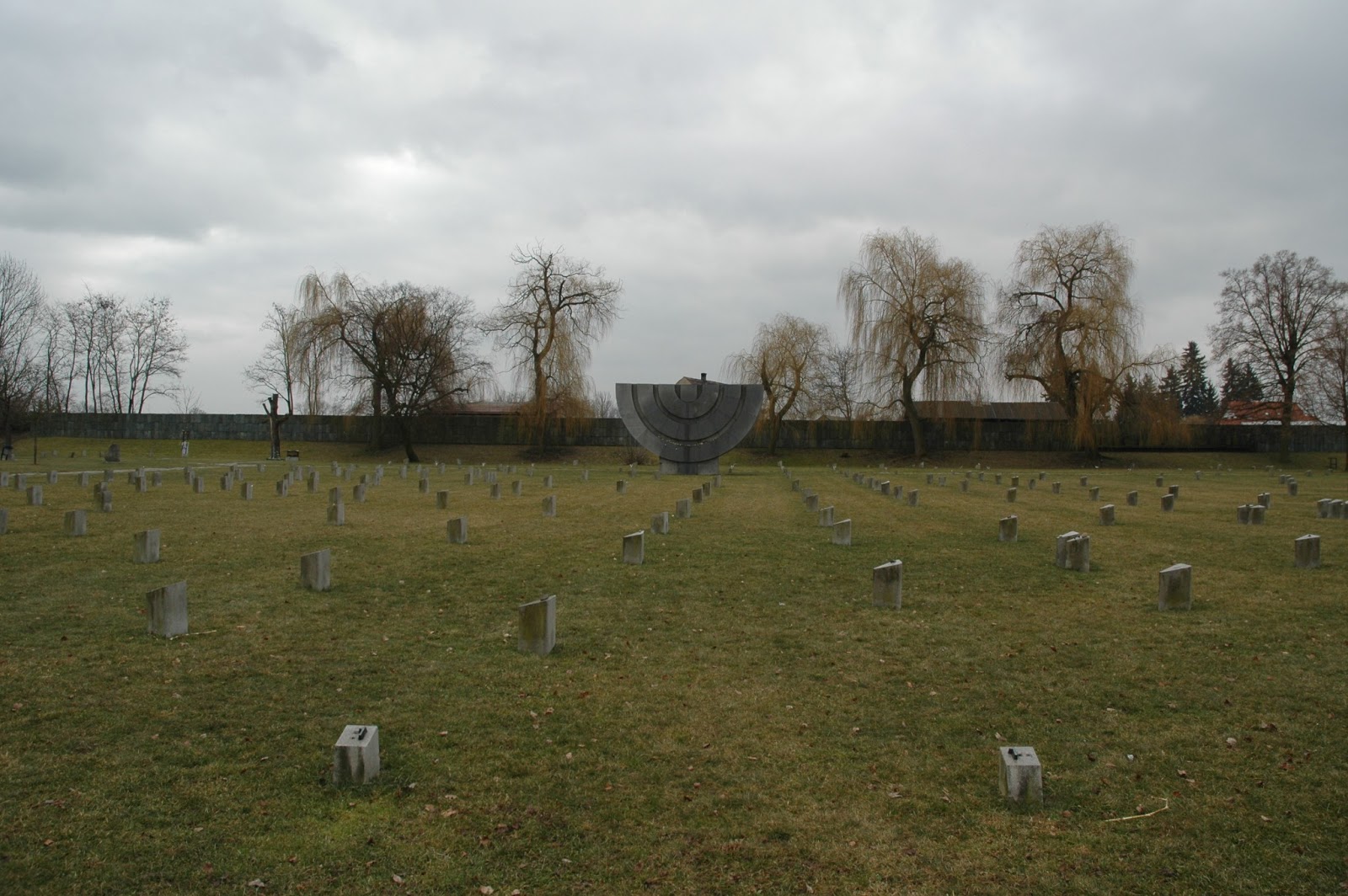
This cemetery/memorial is right next to the crematorium which, in the case of Terezín refers not to gas chambers but to the building where the bodies of those murdered were cremated. At first, they kept the ashes in wooden urns, but when those began to take up too much space they forced the prisoners to make paper urns for the ashes of their friends and relatives. Later in the war, as it became clear that Germany was going to lose, the SS officers dumped the ashes into the Ohře River. 
Somehow, Irma Lauscher, a Jewish prisoner who was a volunteer teacher in Terezín  bribed a guard to smuggle a maple sapling into the ghetto to celebrate Tu Bishvat. The large tree in this photo is that original tree, which died a few years ago--but the smaller tree on the left, wrapped in an Israeli flag, is a sapling grown from an offshoot of the original tree. I just learned that another sapling from the Terezín tree is planted outside of the Illinois Holocaust Museum in Skokie, where Grandma is a docent.

Aunt Ruth sent me an NPR piece weeks ago called "Honoring 'Our Will to Live': The Lost Music of the Holocaust," which I only got around to listening to today. In it, Sylvia Poggioli reports: "The Terezín was camp unique. It was ghetto, concentration, and transit camp all in one that the Nazis used as a cultural showcase to deceive the Red Cross and for propaganda purposes." In our visit to the Magdeburg Barracks, there were hundreds of drawings, some done by prisoners who drew propaganda in the drafting office but often stole materials to make their own, secret drawings. We saw sheet music written and prepared in the camps, poems written about daily life--including the famous poem "I never saw another butterfly" by Pavel Friedman. There were copies of the newspaper Vedem, which the boys of the ghetto produced in secret, and which was written (with the exception of a few editorials) entirely by children. The prisoners also produced plays, dramas, and operas, including Brundibárwhich was performed 55 times at Terezín.


More eeriness, the irony of which I can imagine was not lost on the political prisoners trapped at Terezín, where they could see the mountains in the distance even as they walked to the Small Fortress, which was also at Terezín but was separate from the Jewish ghetto. The Small Fortress was the largest Gestapo prison in the Protectorate of Bohemia and Moravia. Although Terezín is most (in)famous as a Jewish ghetto and concentration camp, its history as a garrison town actually dates back to the 18th century.
After passing through the offices where you would have waded through the Nazi bureaucracy, you would have walked through the archway reading "arbeit macht frei (work makes you free)." I found the beautiful weather (crisp and cold, but sunny with a blue sky) to be kind of a creepy contrast to the "arbeit macht frei" sign, especially since there have been only about four blue-sky days since I've been here. 


Looking out from the bedroom/mess hall of (non-Jewish) political prisoners. 

Next to the room above (for non-Jewish political prisoners) was the cell for Jewish prisoners. It was significantly smaller, to the point that the 60+ prisoners who would have been there at any given time couldn't even lie down to go to sleep. This window didn't open then, and the only source of clean air circulation was a small, 4-inch by 4-inch hole cut into the wall. This window was the only source of light. 

This "hidden synagogue" was discovered only recently. It's in the basement level of an "apartment" that housed 15 people. The inscription in this photo, painted by Asher Berlinger, reads "ותחזינה עינינו בשובך לציון ברחמים," an excerpt from the daily Amidah prayer that means, "May our eyes behold your return to Zion in Mercy." I'm not sure who Ann Golbderg is, but she seems to have the full scoop on the discovery of this synagogue in a blog post, which you can read here.

This room, lined with sinks and mirrors, was constructed entirely as a piece of Nazi propaganda in advance of the Red Cross inspection that came to check conditions at Terezín in June 1944. The Nazis spruced up the camp for the visit--in reality, showers and laundry were a scarce luxury, and prisoners certainly weren't provided with mirrors. When the day of the visit came, the Red Cross officials didn't even make it to this part of the camp, and the room was never used. After the Red Cross visit, the Nazis put out this propaganda video, to prove the cultured quality of life they were providing for Jews at Terezín

Although the Small Fortress was unrelated to the Jewish ghetto part of Terezín, there were of course Jewish prisoners who were sent to that part of the camp. The Jewish cells in the Small Fortress were single-person cells measuring about 5 feet wide by 7 feet deep. This is the roof they would have looked at as they tried to fall asleep on their wooden beds, knowing that they'd likely be shot in the next few days--and if not, that they'd be sent on a "transport," where they would certainly be killed. The "dormitories" of the non-Jewish prisoners at the Small Fortress were much bigger, housing 300 per room in stacked, shoulder-to-shoulder bunk beds.

Cemetery of political prisoners right outside the Small Fortress.


By the end of our trip, the color of the sky looked more appropriate for the setting.

Saturday, February 23, 2013

#100: Purim comes to Prague

I learned on Facebook that the kindergarten at Akiba Schechter is about to celebrate its 100th day of school, which I remember as being a Very Big Deal from when I was five. The participants in the thread were discussing possible items that students could bring one hundred of in order to mark the occasion (I don't remember what I brought, though probably something like 100 M&Ms, or 100 paper clips). On the same day as I read that conversation, I realized that my next post would be my one-hundredth blog post since starting when I went to Israel three-and-a-half years ago. One hundred is a pretty special number, so I knew that the hundredth blog post had to be pretty special. Purim is special, so I guess that works.

And so I bring you....Purim in Prague! [Plus a couple other things. Like snow and glass harps.]


It all began last weekend, when I bought all the ingredients for Dad's/The Bubbe's hamentashen recipe. Because I knew that if I bought them, I'd have no choice but to make the dough and filling! So on Wednesday I got my hands dirty and did all the patchkey-ing that comes with kneading dough by hand. And since don't have a food processor either, I chopped the raisins, prune, and walnuts as best I could for the poppyseed filling. On Thursday night, my roommate Sara and I made them--they weren't exactly the same as at home (for one, I forgot to glaze them) but still, they were delicious!


[This is not about Purim.] It snowed today! A lot! I'm not the best at estimating depth, but I'd say by the end of the day there was probably at least 5-6 inches. For the first time this year, I got to see a substantial amount of snow falling from the sky. It was quite exciting, and justified my decision to wear my hiking boots to shul with my dress. My friend Gaby, who is studying abroad here on another program, got this picture of me eating snow off a car on our way from services to Kiddush-hopping/Shabbat lunch. (Shabbat lunch, by the way, was wonderful. There's an Israeli man who has lived in Prague for quite a while, and his brother and his band was visiting Prague this weekend and they sang the most beautiful harmonies to Shabbat songs!)

[The following video is not about Purim either, but it's something cool I saw.] The "Czech buddies" (Czech students who live with us) organize Czech Tables a few times every month, and you can go to as many as you want. In theory, it's supposed to be an informal gathering at a cool local place where you can practice your Czech, but in reality is just a way to hang out with people and get the program to pay for things. This afternoon I went to the Grand Orient Cafe, which is located in the House of the Black Madonna, a cubist building constructed in the early 20th century. (If you're interested, the crepes I got there with hot raspberry sauce, vanilla ice cream, and whipped cream were delicious.) On my way to the cafe from Shabbat lunch, however, I passed this guy playing wine glasses:


Okay, back to Jew-y things.

The Masorti (Conservative) community has services every Friday night, which I'm really glad I found out about because the Old New synagogue has tiny holes for the women to look through. No fun. Somehow I got myself into "interning" for Masorti Prague Abroad, helping organize and publicize events for students here for a semester. This Shabbat was the first time we had an event (services followed by dinner at the Dinitz kosher restaurant. Such good food!). For the first time ever, I led Maariv, and this was what I got to look at as I led! It's the Vysoka (High) Synagogue in the same building as the Jewish Town Hall. This weekend was actually a Double Shehecheyanu for me, because I also read Megillah for the first time! (Last year doesn't count, because it was three verses.)
Besides Gaby and me, the other person to read Megillah was Shumi [Insert Last Name], who used to carry Shlomo Carlebach's bags for him. I'm not sure what his story is, but he seems like an interesting guy who I'll get to know more, because he seems to be around all the time. There was also a wonderful Israeli family visiting Prague this weekend who invited me for a meal when I go to Israel to visit Naomi, et al. over Passover!
.
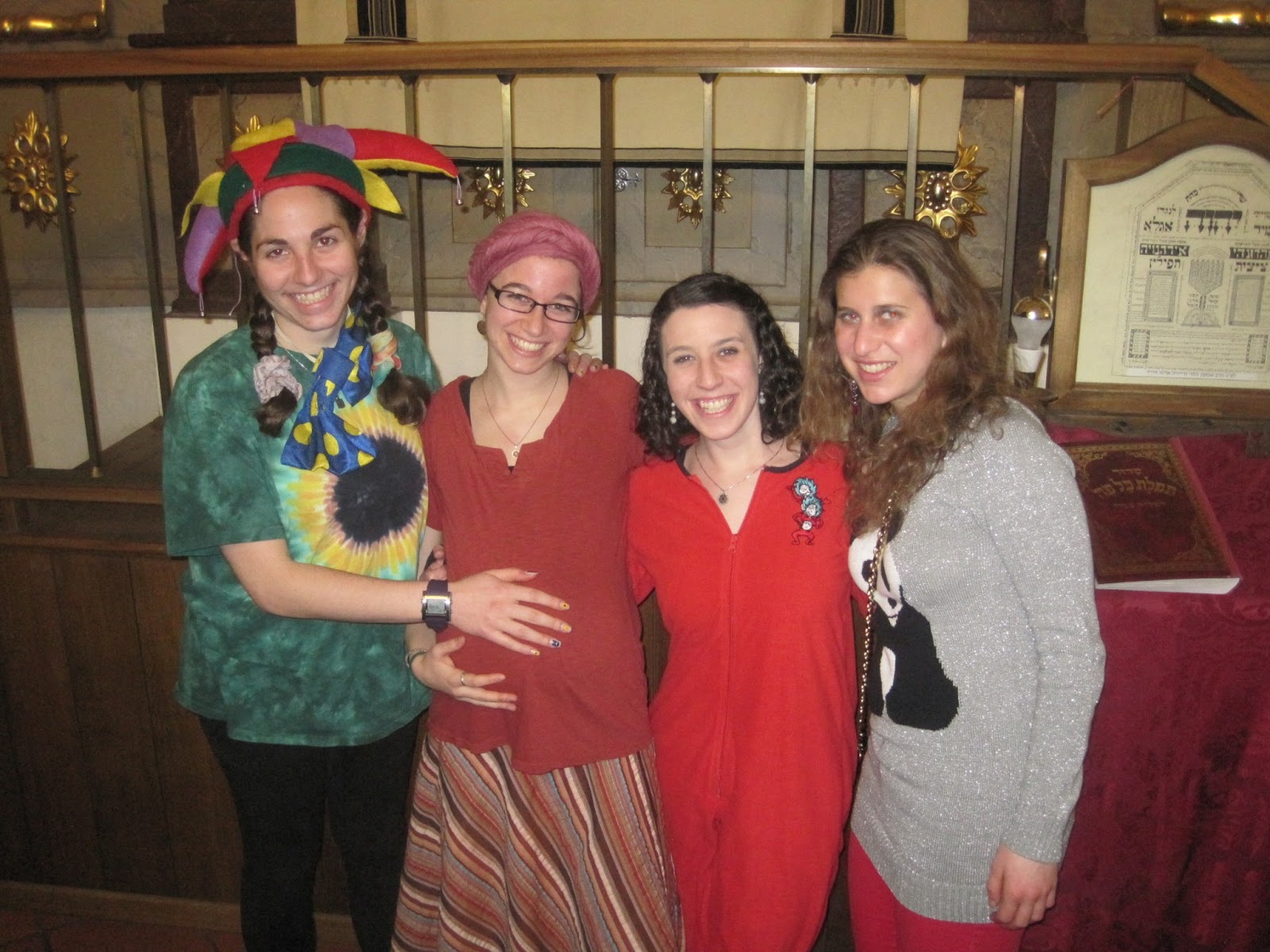
Except for one kid and a few scattered adults with masks, the four of us were the only ones who dressed up for Purim. Maybe costumes are not a thing in Prague? (Though we found out later, at the community's Purim party, that that's not true. So many just no one wore costumes to our service). The four of us are all studying abroad here on three different programs.  It was great to meet some students from other study abroad programs, because mine is so small and it's nice to expand the circle a little bit, and I think that my "internship" (yes, the quotation marks are there for a reason) will help me meet more people than I would have otherwise met.


In case you couldn't tell what my costume was from the previous picture, it's my usual: pregnant religious woman. Comments/questions I received: "Is it real?" "Is it by King Achashverosh?" "Wait, you weren't like that this morning!"


After the reading, Gaby and I headed downstairs to check out the community's Purim party. Our first site: The Tall Man playing violin. Later in the night, he danced to the music of the jazz band playing upstairs, and it was hilarious to watch because it looked like his "knees" were always buckling backwards. 


A Purim spiel, as performed by Divadlo Feigele, a children's theater company formed about 30 years ago in the Jewish community! This is the scene of the beauty contest, where King Achashverosh is picking his new queen after throwing Vashti out of the palace. In the red is Esther, and next to her Mordechai is trying to convince her to put herself in the running. The little girls are the princesses, and there are also hand-puppet/marionettes!


The whole cast of Divadlo Feigele. 

Obviously we couldn't understand many of the actual words that were spoken in the spiel, but it was really cool to be able to follow nonetheless, because we're so familiar with the story. The video below is the scene where Haman is forced to lead Mordechai around on a royal horse wearing the King's clothes proclaiming, "This is what is done for the man whom the king wishes to honor.":


Gaby and I decided to venture upstairs, and what we discovered there was the real party! Karaoke, a bar, and lots of local Jews our own age (who knew those even existed!?). After a while we noticed this bizarre portrait of Franz Josef, the last monarch of the Hapsburg Empire. He was relatively tolerant of the Jews (we just read his edict of "semi-emancipation" of the Jews in one of my classes), so I guess that's reason enough to have a portrait of him? The room, one the fourth floor of the Jewish Town Hall, was quite extravagant--red wall-papered wall, gilded paint, big crystal chandeliers....
The flutist (floutist? flautist?) was excellent! I don't think I've ever heard jazz flute before, and if you haven't either you should take a look at this (short) video:


Gaby and I with Rabbi Michael "Einstein" Dushinsky. Rabbi Dushinsky (he goes by "Dushi," which sounds like another word that's not so nice) is quite a character. He's also the one who helped me learn the part of the Megillah that I read.
And the Purim fun only continues tomorrow! I'll get to hear Rabbi Dushinsky read Megillah, and then there's a Chabad Purim Disco (???) tomorrow night that I think I'll go to. I'm not sure when I'll do my reading, but it'll get done.